Why the Moon Has Two Different Faces?
The Moon's two hemispheres couldn't look more different. One is covered by vast volcanic plains, the other by ancient cratered highlands. Why did two sides of the same world evolve so differently?

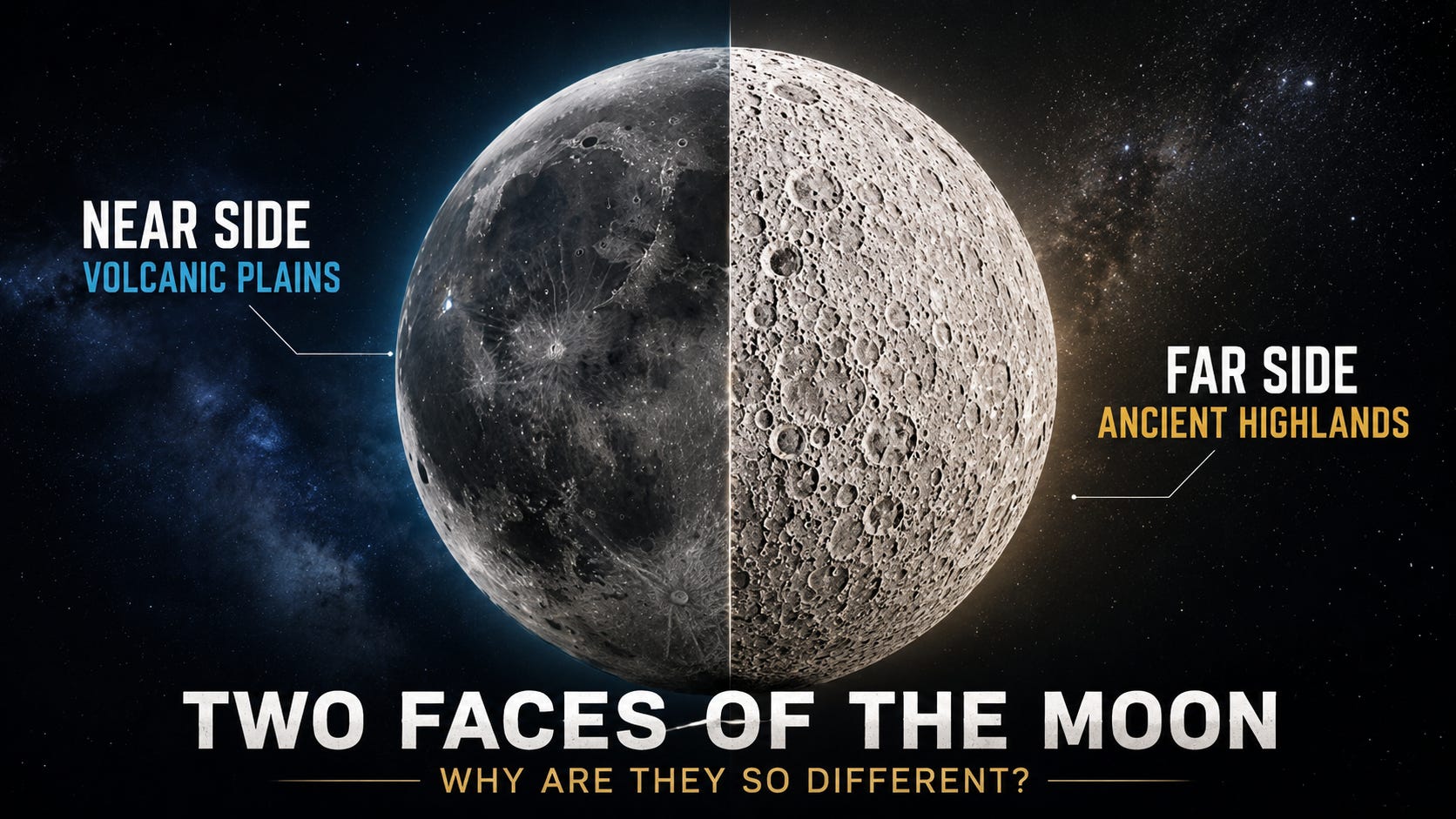
If you look at the Moon with the naked eye, one feature immediately stands out. Large dark patches spread across its surface, forming patterns that people have imagined as rabbits, faces or even a man looking back at Earth. Early astronomers called these regions maria—”seas” in Latin—because they believed they were vast bodies of water. We now know they are not seas at all, but immense plains of solidified basalt produced by some of the largest volcanic eruptions in the history of the Solar System.
For centuries, however, nobody realized that these dark plains are only part of the story.
When the Soviet spacecraft Luna 3 returned the first photographs of the Moon’s far side in 1959, planetary scientists were astonished. Instead of another hemisphere covered with dark volcanic plains, they found an entirely different world. The far side is brighter, more rugged and almost completely devoid of maria. Only about two percent of its surface is covered by volcanic basalt, compared with roughly one third of the hemisphere facing Earth. The two sides of the Moon look so different that they almost appear to belong to two separate worlds.
The obvious question is why.
According to the leading model, the Moon formed about 4.5 billion years ago after a giant collision between the young Earth and another planetary body, commonly known as Theia. Material ejected into orbit gradually coalesced into the Moon, although scientists still debate exactly how much of that material originated from Earth and how much came from the impactor. Whatever its precise origin, the newborn Moon was initially covered by a global—or nearly global—ocean of molten rock hundreds of kilometres deep. As this magma ocean slowly cooled, it fundamentally shaped the Moon we see today.
The crystallization process acted like a giant planetary sorting machine. Dense minerals such as olivine and pyroxene gradually sank into the lunar mantle, while lighter plagioclase floated upward to form the first anorthositic crust that still dominates the bright lunar highlands. The last remaining pockets of molten material became increasingly enriched in elements that did not fit easily into the crystal structures of the earlier-forming minerals. These included potassium, phosphorus, rare earth elements, and elevated concentrations of uranium and thorium. Planetary geologists collectively refer to this chemically distinctive material as KREEP.
Although KREEP represents only a small fraction of the Moon’s crust, it may have played a disproportionately important role in its geological evolution. Uranium and thorium continuously release heat through radioactive decay, allowing KREEP-rich regions to remain warmer than their surroundings for hundreds of millions of years. Modern orbital missions have shown that surface signatures of these heat-producing elements are concentrated overwhelmingly within the Procellarum KREEP Terrane, a vast province beneath the hemisphere facing Earth. This prolonged internal heating likely helped sustain magma production long after much of the Moon’s interior had begun to cool.
The real mystery, however, is how this remarkable asymmetry developed in the first place.
One intriguing possibility reaches back to the very earliest days of the Earth-Moon system. Shortly after the giant impact, the Moon orbited much closer to Earth than it does today and probably became tidally locked remarkably quickly. At the same time, Earth itself was still covered by its own magma ocean, radiating enormous amounts of heat into space. Some researchers have proposed that this intense thermal radiation slowed the cooling of the lunar nearside, while the farside, facing away from the glowing Earth, cooled more rapidly. If correct, this temperature difference could have influenced where crust-forming minerals accumulated, helping to produce a thicker crust on the farside. It is an elegant idea, but it remains one of several competing hypotheses rather than a settled explanation.
Another important piece of the puzzle may be the South Pole–Aitken Basin, the largest and deepest clearly recognized impact basin on the Moon. Stretching roughly 2,500 kilometres across, it formed when an enormous asteroid struck the young lunar surface during the earliest stages of Solar System history. Recent numerical models suggest that this colossal impact may have profoundly altered the Moon’s interior, generating large-scale mantle convection that redistributed heat-producing material toward the hemisphere facing Earth. Other researchers argue that the basin instead modified the Moon’s long-term thermal evolution in more indirect ways. At present, no single explanation has gained universal acceptance, and the final answer may involve several processes acting together.
What we do know is that the lunar crust is not equally thick everywhere.
Measurements from NASA’s GRAIL mission revealed that the crust beneath the near side is significantly thinner than beneath much of the far side. Although the difference amounts to only a few tens of kilometres, it dramatically affected the ability of magma to reach the surface. A thinner crust requires less pressure to fracture, making volcanic eruptions considerably more likely. By contrast, magma rising beneath the farside would often have stalled within the thicker crust before it could erupt.
The formation of enormous impact basins further amplified this contrast. Basins such as Imbrium, Serenitatis and Crisium excavated vast depressions, fractured the crust and reduced the distance magma had to travel before reaching the surface. These impacts did not necessarily trigger immediate volcanic eruptions—many of the maria formed hundreds of millions of years later—but they created favourable pathways and topographic lows into which basaltic lava could eventually spread.
The result was one of the most extensive episodes of volcanism in Solar System history. Over hundreds of millions of years, enormous volumes of basalt flooded many of the great impact basins on the hemisphere facing Earth, producing the familiar dark maria visible even without a telescope. The broader Oceanus Procellarum region also became the centre of exceptionally widespread volcanic activity. These eruptions built shield volcanoes, generated explosive pyroclastic deposits and carved spectacular sinuous rilles—winding valleys formed not by flowing water, but by rivers of lava hot enough to thermally erode the lunar surface.
The farside followed a very different evolutionary path. With a thicker crust and much less extensive volcanism, it largely preserved the rugged landscape created during the intense early bombardment of the inner Solar System. As a result, the two hemispheres evolved in strikingly different ways despite sharing the same origin.
Perhaps that is what I find most fascinating about the Moon. It is the closest world beyond Earth and the celestial body we know better than any other. Yet one of its most obvious characteristics—the fact that its two hemispheres look almost like different planets—remains only partly understood. We have identified many of the ingredients that shaped this remarkable asymmetry, from the crystallization of the magma ocean and the concentration of radioactive elements to giant impacts and variations in crustal thickness. What we still lack is a complete understanding of how these processes interacted during the Moon’s earliest history.
That is one of the reasons I am so excited about humanity’s return to the lunar surface. Whether the next astronauts arrive under the American flag through Artemis or under the Chinese flag as part of the International Lunar Research Station ultimately matters far less than the science they will bring back. Every new sample collected from unexplored regions of the Moon has the potential to refine our models of its interior, improve our understanding of its volcanic history, and perhaps even reveal why the two hemispheres followed such different evolutionary paths.
So we have to just wait a bit…
If you enjoy deep dives into planetary science, experimental research and the strange physics shaping other worlds, consider subscribing. Every week I explore new discoveries across the Solar System—and occasionally take you inside the laboratory where we try to recreate alien worlds here on Earth.