Fifty Years Since Humanity First Landed on Mars: How Viking 1 Changed Our View of the Red Planet
The mission that gave us our first true view of Mars—and launched a debate about extraterrestrial life that continues to this day.

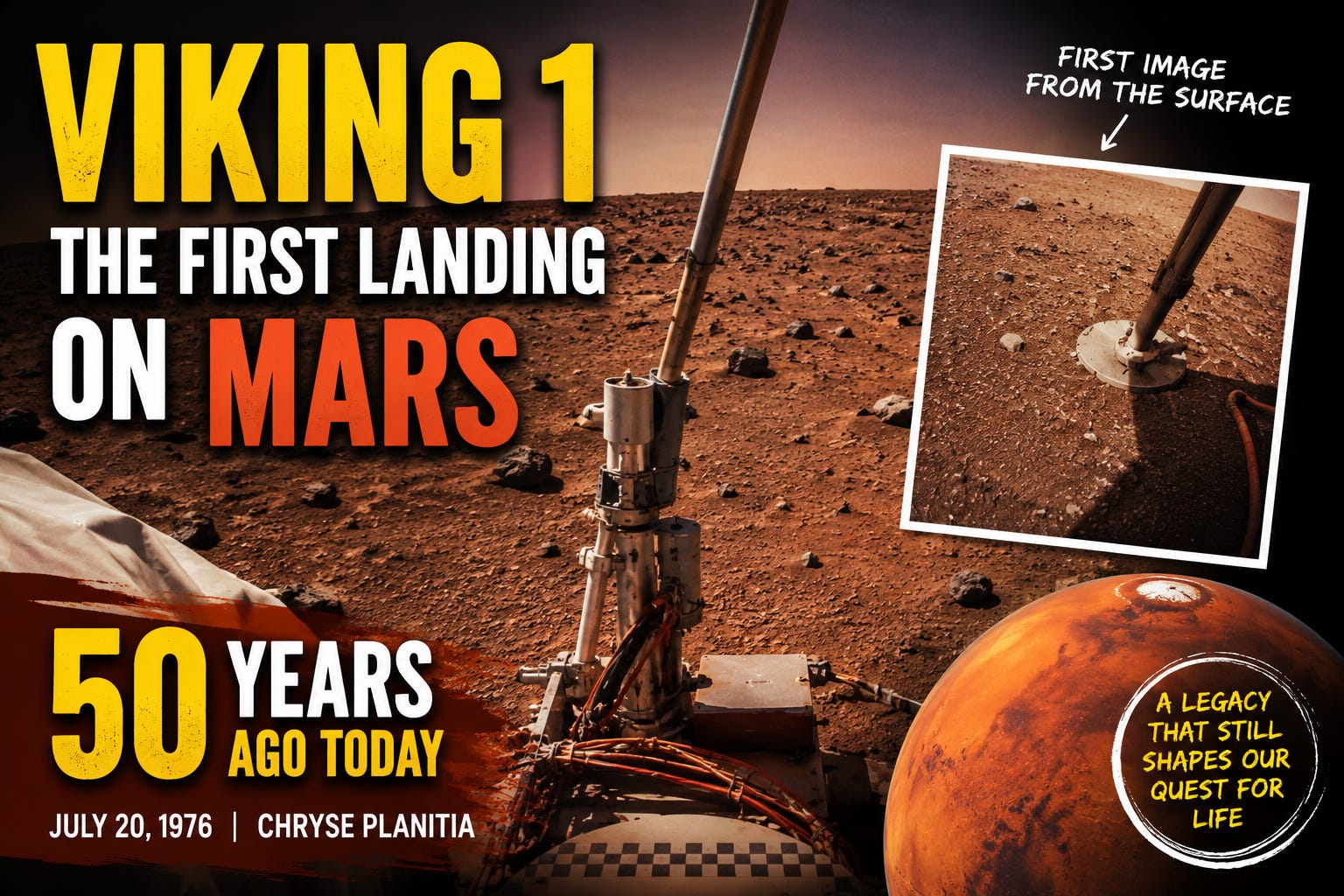
A parachute blossoms several kilometers above the rusty Martian landscape after a metal spacecraft survives its fiery plunge through the thin atmosphere at more than a thousand kilometers per hour. The parachute is essential, but it can only do part of the job. Mars’ atmosphere is about 180 times thinner than Earth’s, making aerodynamic braking far less effective than it is here at home.
At an altitude of roughly 1.5 kilometers, the lander jettisons its heat shield. Moments later, the parachute is released as well. From a few hundred meters above the surface, three retrorockets take over, slowing the spacecraft for the final descent. Their exhaust kicks up clouds of reddish dust. The landing pads sink gently into the fine regolith. The engines shut down.
Silence.
It is July 20, 1976—exactly seven years after Apollo 11 landed on the Moon. NASA’s Viking 1 has just become the first American spacecraft to achieve a successful soft landing on Mars.
Yet nobody in mission control celebrates immediately.
The radio signal still has to travel more than 300 million kilometers back to Earth. Confirmation of a successful landing will not arrive for another nineteen minutes. Only then does the Jet Propulsion Laboratory erupt in applause. Scientists and engineers embrace, shake hands, and open bottles of champagne.
After more than a decade of planning and development, they have achieved something no one had ever done before. Humanity has successfully placed one of its machines on the surface of Mars, opening an entirely new chapter in the exploration of the Solar System.
Seeing Mars Up Close
Today it almost feels routine.
Images from Mars appear on social media almost daily. Curiosity and Perseverance send home thousands of photographs, drill into rocks, and analyze their chemistry. Multiple orbiters continuously map the planet at resolutions that Viking’s engineers could scarcely have imagined.
But in the summer of 1976, Mars remained a world filled with mystery.
NASA’s Mariner missions had already revealed giant volcanoes, canyons stretching farther than Europe, and dried-up river valleys carved by ancient water. Yet no one knew what Mars actually looked like from ground level. Scientists knew it possessed a thin atmosphere, freezing temperatures, and countless impact craters—but they had never seen the landscape from the perspective of someone standing on its surface.
The answer arrived only minutes after landing.
To many people, Viking’s very first image was a surprise.
Instead of revealing a sweeping Martian horizon or a dramatic alien landscape, the photograph showed little more than one of the spacecraft’s landing legs and the ground immediately beneath it.
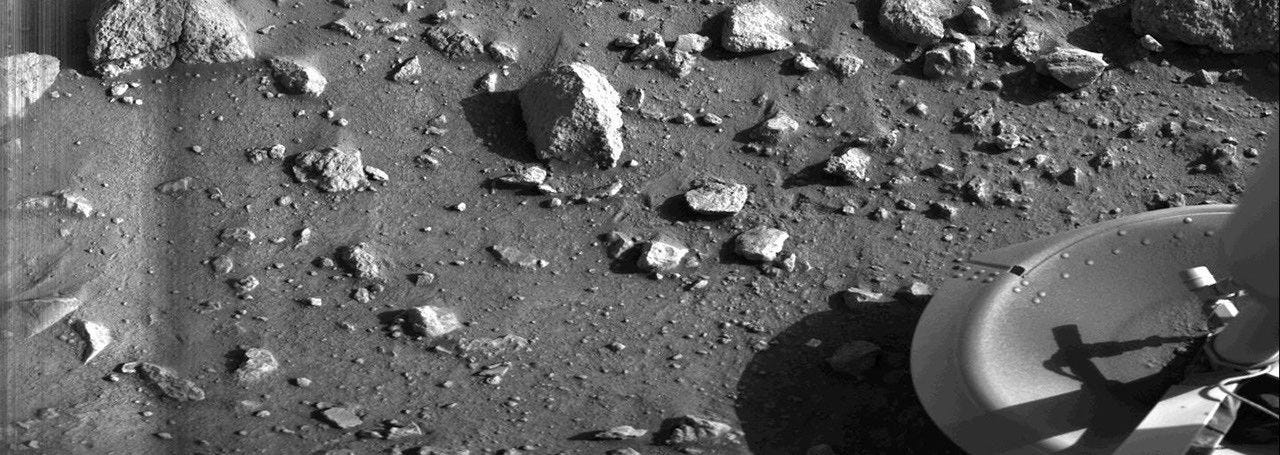
This is the first photograph ever taken on the surface of the planet Mars. It was obtained by NASA’s Viking 1 just minutes after the spacecraft landed successfully July 20, 1976. Image Credit: NASA/JPL
At first glance, it almost looked like a missed opportunity. In reality, it was exactly the image engineers needed.
Before worrying about scenic views, they had to answer much more practical questions. How deeply had the landing pad sunk into the soil? Was the ground firm enough to support the spacecraft? Was it covered by fine dust, sand, or larger rocks?
The photograph provided reassuring answers almost immediately. The landing pad had left only a shallow imprint, while the surrounding terrain consisted of a mixture of fine dust, sand, and rocks of various sizes.
It was, in essence, the first direct geological investigation ever carried out on the surface of another planet.
Only then did Viking turn its cameras toward the horizon.
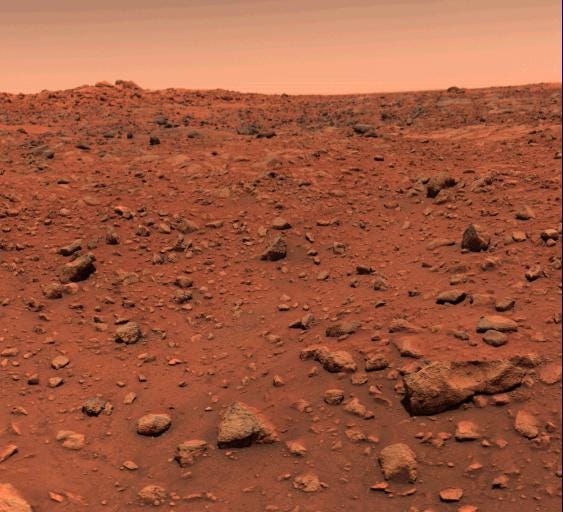
First Color Image From Viking Lander 1. JPL, Public Domain.
For the first time, humanity saw the plains of Chryse Planitia from ground level. The rocky landscape stretched into the distance beneath a salmon-colored sky—a color that sparked considerable debate at the time. Today we know that this unusual hue is produced by fine dust rich in iron oxides suspended throughout the Martian atmosphere.
Viking also returned the first true color images from the surface of Mars.
For the first time, we were no longer looking at maps or black-and-white orbital photographs. We were seeing another planet as it would appear to a person standing there.
Why Chryse Planitia?
At first glance, Chryse Planitia hardly seems like an extraordinary place.
There are no towering volcanoes or immense canyons. Instead, it is a vast, gently rolling plain scattered with rocks of every size. What appears geologically unremarkable today was precisely what Viking’s designers were looking for.
The spacecraft had only one chance to land successfully.
No previous mission had achieved a soft landing on Mars, and engineers had only limited confidence in how the spacecraft would behave during atmospheric entry, parachute deployment, and powered descent. Every unnecessary hazard had to be eliminated.
Chryse Planitia also offered another crucial advantage.
As one of the lowest regions on Mars, it possesses a slightly denser atmosphere than the surrounding highlands. That small increase in atmospheric density provided the spacecraft with a few extra seconds of aerodynamic braking—seconds that could easily have made the difference between success and failure.
Safety, however, was only part of the reason for selecting the site.
Images returned by Mariner 9 had already shown that several enormous outflow channels converge in Chryse Planitia. These valleys were likely carved by catastrophic floods billions of years ago. If liquid water had once flowed across Mars, this basin would have accumulated sediments transported from vast areas of the planet, making it one of the most promising locations to search for signs of ancient life.
Ironically, scientists may have been luckier than they realized.
Modern research suggests that Viking 1 may have landed not far from the shoreline of a hypothetical northern ocean that could once have covered much of Mars’ northern hemisphere. Some of the boulders visible in Viking’s first photographs may therefore have arrived not by rivers or glaciers, but as debris transported inland by gigantic tsunamis triggered by asteroid impacts into that ancient ocean.
Viking, however, was far more than a camera on legs.
It carried one of the most sophisticated scientific laboratories ever sent to another world. A weather station continuously monitored temperature, atmospheric pressure, and wind speed. An X-ray fluorescence spectrometer analyzed the chemical composition of rocks and soil. A gas chromatograph–mass spectrometer searched for organic molecules, while a robotic sampling arm collected Martian soil and delivered it into the spacecraft for detailed laboratory analysis.
From the very beginning, Viking was designed to do far more than study Martian geology or weather.
Its primary goal was to tackle one of the biggest scientific questions of all:
Does life exist on Mars?
The Search for Life
When Viking was conceived in the early 1970s, the idea of finding life on Mars did not seem nearly as far-fetched as it does today.
Ever since the late nineteenth century, reports of supposed Martian canals had fueled speculation about intelligent civilizations inhabiting the Red Planet. Even decades later, many scientists still considered it entirely plausible that simple microorganisms might survive beneath the Martian surface—or perhaps even within the soil itself.
Mariner 9 had strengthened those hopes. It revealed dried-up river valleys, enormous flood channels, and other geological features that pointed to a wetter and potentially habitable Mars billions of years ago. And wherever there had once been liquid water, many researchers believed there might also have been life.
That belief shaped Viking’s most ambitious scientific objective.
Rather than searching for fossils or looking through a microscope for tiny organisms, NASA took a much bolder approach. Viking would search for life directly by looking for metabolism—the chemical reactions that living organisms use to obtain energy.
No spacecraft had ever attempted anything like it.
The two Viking landers each carried three biological experiments specifically designed to detect signs of active microbial life.
The idea was remarkably elegant.
A robotic arm collected samples of Martian soil and delivered them into small sealed chambers inside the spacecraft. There, the instruments added water and nutrient solutions containing radioactively labeled carbon. If microorganisms were present, they would consume the nutrients and release radioactive gases that the instruments could detect.
Then something extraordinary happened.
One of the experiments—the famous Labeled Release (LR) experiment—produced exactly the kind of response scientists had hoped to see. Shortly after nutrients were added, the instrument detected a rapid release of radioactive gas, a signal strikingly similar to what microbial metabolism would produce on Earth.
For a brief moment, excitement spread through the Viking science team.
Some researchers believed they had just witnessed humanity’s first evidence of extraterrestrial life.
The celebration, however, did not last.
The other two biological experiments failed to find any signs of life. Even more troubling, Viking’s gas chromatograph–mass spectrometer detected no organic molecules at all—the carbon-based compounds that form the chemical foundation of every known form of life on Earth.
The results seemed to contradict one another.
How could something appear to metabolize nutrients if no organic molecules were present in the soil?
As the years passed, most scientists concluded that Viking had not discovered Martian life after all. Instead, they argued that highly reactive chemicals in the Martian soil had produced purely chemical reactions that mimicked biological activity when water was added.
For decades, that explanation became the accepted interpretation.
Then, in 2008, another NASA mission provided a crucial missing piece of the puzzle.
The Phoenix lander discovered perchlorates in Martian soil—highly reactive salts whose existence was completely unknown when Viking flew. That finding transformed scientists’ understanding of the Viking experiments.
Perchlorates offered a compelling explanation not only for the unexpected reactions observed in the biological experiments, but also for the apparent absence of organic molecules. Viking’s gas chromatograph–mass spectrometer heated soil samples before analyzing them. We now know that when perchlorates are heated, they can destroy organic compounds before the instrument has any chance to detect them.
In other words, Viking may have had organic molecules sitting right in front of it all along.
Its own analytical method may simply have destroyed the evidence before it could be measured.
Nearly fifty years later, the Viking biology experiments remain among the most debated results in the history of planetary exploration.
Most researchers now favor the explanation that the spacecraft detected unusual Martian chemistry rather than living organisms. Yet a small number of scientists continue to argue that the results cannot be dismissed completely and deserve continued discussion.
Whether Viking detected life or not, the mission accomplished something equally important.
It demonstrated just how extraordinarily difficult it is to recognize life on another world—and how easily unfamiliar planetary chemistry can imitate biology. That lesson continues to shape every life-detection mission designed today.
Viking’s Legacy
The Viking landers were originally designed to operate for just 90 days.
Instead, Viking 1 remained active on the Martian surface for more than six years, while its twin, Viking 2, continued working for almost four. During that time, the two spacecraft returned tens of thousands of images, monitored the Martian weather day after day, and recorded seasonal changes that no one had ever observed before.
Their companion orbiters proved just as important.
Together, they mapped nearly 97 percent of the Martian surface at an unprecedented resolution. For the first time, scientists could study Mars as a complete planet while simultaneously comparing orbital observations with measurements made directly on the ground—a strategy that has become the standard for every successful Mars mission since.
Although Viking never delivered a definitive answer about life, it fundamentally changed our understanding of Mars.
The mission showed that Mars is far more complex than we had imagined. Its atmosphere is dynamic, producing weather and global dust storms. Its rocks preserve a long geological history. And its soil hosts chemical processes so unusual that they fooled some of the most sophisticated life-detection experiments ever sent to another world.
Every major Mars mission that followed built on Viking’s achievements.
Pathfinder proved that robotic rovers could successfully explore the Martian surface. Spirit and Opportunity uncovered compelling evidence that liquid water once persisted on Mars for extended periods. Curiosity demonfistrated that Gale Crater once offered conditions suitable for microbial life. Today, Perseverance is exploring the ancient delta of Jezero Crater, collecting carefully selected rock samples that scientists hope will one day be returned to Earth.
Ironically, these later missions also helped solve one of Viking’s greatest mysteries.
We now understand why Viking failed to detect organic molecules. By heating its soil samples before analysis, the spacecraft unknowingly triggered chemical reactions involving perchlorates that destroyed many organic compounds before they could be measured.
In hindsight, Viking may have been closer to discovering organic material than anyone realized.
The first confirmed detections had to wait until the twenty-first century. Curiosity identified organic molecules preserved within ancient sedimentary rocks in Gale Crater, while Perseverance is now finding additional organic compounds in the sediments of Jezero’s fossil river delta. Whether these molecules originated through geology or biology, however, remains an open question. Only detailed analyses in terrestrial laboratories may eventually provide the answer—assuming the collected samples are ever brought back to Earth.
Half a century after Viking 1 touched down on Mars, we are still pursuing the same question that inspired the mission in the first place:
Did life ever exist on Mars?
Today we know incomparably more about the Red Planet than the scientists of 1976 could ever have imagined. Yet the answer to that one fascinating question continues to elude us.
Perhaps that is Viking’s greatest legacy. It did not solve the mystery of life on Mars. It showed us just how difficult the mystery would be to solve.
If you enjoy deep dives into planetary science, experimental research and the strange physics shaping other worlds, consider subscribing. Every week I explore new discoveries across the Solar System—and occasionally take you inside the laboratory where we try to recreate alien worlds here on Earth.